
Thrashing Machine {cfp}
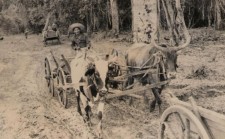
THE THRASHINGMACHINE
Wilhelm Fischer was my boss. At six, one morning he met me with the news, that he had something very exiting for me to do “I wish that I could do this job” he commented. Nothing new in that, most of the assignments he came up with for me in those days were ‘exiting’, I was fourteen years old, 1953. All my life I had admired and liked Wilhelm because of his capabilities and more important: his jovial character with an endless supply of energy. Never once in all the years that I have known him, has he ever shouted at me or threatened me in any way. To this day I consider myself very lucky and fortunate to have known Wilhelm Fischer! Wilhelm never complimented me about my achievements, anyhow, not to my face, that would be very ‘un-Bruderhof’ to compliment someone like me, me being ‘Untermensch’ on the Bruderhof. Wilhelm knew that I was a lot more successful in executing difficult tasks/jobsw, than most adult men, when it came to oxen who have 'attetude problems'.
This job Wilhelm wanted me to do: Was, to go to Isla a neighbouring village with two oxen and the front end of a wagon from Loma Hoby, the village I lived in at the time, to collect the McCormick thrashing-machine, the next day take it to Volendam, about 100 km away ‘as the irrivú flies, looking for carrion’. Volendam was a new colony, founded in 1948 and named after the ship or rather ‘bucket’ that brought those 'refugees' Eastern Europe and from the upper Rheinland to Paraguay, were they settled and built their new home or 'Heimat'. On the next voyage, to North America - The Volendam sunk, just off Sable Island near Nova Scotia Canada, on it’s way back to Europe for more refugees that needed ‘resettlement’, she was a flat bottom boat, of the Rhein, that is why she could go all the way up the Paraguay river, well past Puerto Rosario to San Pedro.
The people of Volendam had planted rice but had no way of thrashing it, so they asked the Bruderhof to lend them their thrashing-machine. It was my job to take the thrashing-machine to Volendam Colony and help them with the thrashing as I knew how to use this Mc Cormick Harvester too. First it was driven by an old Munktel and when that broak down by a steemengine that posed a huge fire hazzard!
This thrashing-machine had already played a big part in my life. I can remember it arriving in Isla Margarita, were I was living at the time, in 1946. Quite unbelievable: it arrived in a huge wooden case made out of Canadian pine. This case was so big that it would not fit on a normal wagon. A wagon had to be dismantled in two halves and reconnected by two long, strong beams and this huge ‘box’ perched, precariously balancing on this ‘carriage’ that was pulled by six horses. Menonites are clever People!
This Thrashingmachine had been ‘donated’ to the Bruderhof by The Manchester Guardian Newspaper. The founder's name was Mr C P Scott, his two daughters May and Olive Scott, had joined the Bruderhof. The Bruderhof knew how to milk situations and people like that. The Manchester Guardian People knew how to distinguish between a ‘Napoleon’ and a ‘Drummer’ (Animal Farm) who existed on the Bruderhof with out any scrooples already at that time. They donated mostly practical items or money for very specific reasons, like the ‘three-bob ewes’ for Bromdon, Shropshire from the Thee Horseshoe Livestock-Auction at Wheathill, Shropshire, on a Saturday afternoon. Those scruffy ewes eventually turned in to one of the finest pedigree flock of Clun Forest Sheep in the UK. Manchester Guardian also paid for the first good rams for the Bruderhof, not to mention the huge amounts of drugs and health-remedies for the Bruderhof Hospital in Paraguay! When most of the Bruderhof left the UK in 1941, they were not allowed to take any agricultural machinery with them to Paraguay from the UK but British War Orphans, without any documentation, children like me were OK, according to the British Government. Absolutely no documents exist to our transportation?
In my very early life, May, the older of the two sisters took me around on horseback, looking for ‘suitable clay’, for making potery and bricks too. The Bruderhof was paranoid about Paraguayan men attacking Bruderhof women, so women needed ‘Bruderhof-male’ company in order to prevent any such attack. I was four years old, that suited May. Many times we both road on a beautiful tall brown horse called Aiax. He was trained by a German, who trained him to ‘Schritt Laufen’ custom of Prussian Military, a very fast walking pace. The reason people did not like Aiax was he could not hide his prick, all the time even in cold weather it would hang out, all twenty-five inches of it, it never bothered May, she just commented, how it gave Aiax “a very manly appearance” I have yet to see a man with twenty-five inches ‘slack’. I use to sit behind her on Aiax, sometimes while Schritt Laufen, his prick would hit the bottom of my bear feet as it was swinging from port to starboard to 'some' rism continuosly. At a trot this never happen. May was suppose to wear a Bruderhof dress in order to conform for Jesus Vetter, she would spread her legs pull the back of her dress to the front and tie it to a bit of rope that she had round her waist, making it look like a dhoti. May was one of those people who contributed a lot to my many adventures and good times in my early childhood!
Later in 1946 that huge empty case was transported to Ibaté, a new village, that was being built to accommodate a hundred orphaned children from Germany, but that never materialized, the German Establishments would not allow children to be ‘transported’ to Paraguay, only the British ‘allowed’ such things cum crimes. Me being in Ausschluß (exclusion) most of my childhood as I was born illegitimate. Sex the most heinous sin on the Bruderhof. Many times Heini Arnold, the Holy Father, a diciple of Jesus Vetter would stated quite categorically: “Die Sünde deiner Mutter ist in dir und die muß ich dir austreiben”! I had to work in Ibaté the new village at that time, early 1947. At night I stayed there alone, so the Paraguayans would not steal the tools and horses as at that time there was amost violent revolution in Paraguay, many people lived in the jungle, surviving from hunting and stealing. I tryed to sleep in this huge case, only dropping of out of sheer fatigue. One side was wide open to the East, on top some cowhides to stop most of the rain from leaking in. The manewolves would be howling close by, I would be terrified, although manewolves don’t attack people but at the age of seven I learned not to believe everything I was told, especially by ‘Brothers’ as most of the time I lived with fear. On the Bruderhof a lot of people became habitual liars and arse-hole crawlers to the ‘po-guazús’ = the Holy Fathers, highly cultivated hypocrisy, no different to Adolph Hitler or Eve Peron we were ruled by fear.
Adults too, being kicked out at that time in Paraguay was a tremendous threat! How would one make a living??
Eventually houses were built and that case became the shelter for horse harnesses at a different location, still with the cowhides on top. The German orphans never arrived, instead a huge group of ‘DP’s’ arrived late in 1948 Europe, and disembarked at Puerto Rosario. As there was not enough shelter, two Russian women, who were ostracized by the Polish and Germans, the Bruderhof moved into this huge case with their two children, next to the ‘horse equipment’. One night as it often happened, the Holy Father Heini Arnold, came to ‘check up on me in bed’, him being a practising paedophile, beat the shit out
of me, for having my hands beneath the blanket, this was because of ‘evil thoughts’ according to him. The beating caused me to loose my voice. Witoldt, a polish farmer, twenty-four at the time, heard the commotion, came to see what it was about? He finished up beating the shit out of Heini Arnold, calling him ‘Rasputin’. Witoldt, hating Germans added grist to the mill. He, and his beautiful wife Bronoslava, then took me to the two Russian women, who lived in the huge case. They had acquired the aliases of Emilia and Modesta to disguise their ‘Russian-ness’. I spent some lovely month living in this case with the two very pretty Russians and their children, who treated me like royalty! These two women had a most miraculous escape from being killed. Their husbands were fighting for the Third Reich. Emilia a Cossack and Modesta a White Russian, they were in camps in Austria and the British wanted to hand them over to the Russians under the ‘Yalta Judgement’. They both escaped the camp, stole a horse and cart and made their way up to Bremen, Germany hoping to find a ship to take them to America. Both knew that their husbands were dead, fighting in Russia. Emilia was twenty-five and her son Allex was four, Modesta was twenty-two and her daughter Olga was two when they left Austria. Now all five of us living in this huge case, that was made in Canada, shipped to the UK with the thrashing machine inside, never opened in Liverpool, were it had arrived but sent on to the Bruderhof in Paraguay on a continued voyage with Lamport & Holt, a Liverpool shipping company in one journey to Puerto Rosario in Paraguay.
Cyrus Hall McCormick (1809 – 1894) who was American, is alleged to be the first inventor of a ‘reaping machine’ and manufactured Harvesters in Chicago since 1847, he was oblivious of were some of his creations finished up and what kind of crops it consumed in it’s huge mouth. Soya Beans were the hardest on its menu, for this or any thrashing machine or combine.
One day Heini Arnold came to ‘collect’ me, so Emilia ambushed him with her nagaika, a Cossack whip, looking like a toy, compared to Paraguayan stock-whips, made entirely out of raw horse leather, had a very high pitched crack, on every impact with Heini it left a blood mark. Holy Heini had to leave empty handed. Eventually I was shipped off to Loma Hoby the other village away from Heini Arnold. Those two women left the Bruderhof. Years later I found Emilia in Argentina, to this day her and Modesta live in Corrientez, Argentina.
Ever since I was kicked out of school, I worked with oxen. I was an orphan on the Bruderhof in Paraguay, although I was born in Nottingham England in 1939. I started working with oxen at the age of seven, in Ibaté. Since then the Bruderhof consisted of three villages, Isla Margarita Loma Hoby and now Ibaté. A huge black and white ox called Tauro was the first ox that I have worked with. Pulling a large and heavy cast iron wheel on its side across the landscape, back and force, so some of the foliage would break and dry out and be able to be burned. That field later got the name ‘Mucky Hollow’. In the middle of it was a much lower bit, were after rain, water collected. Water could escape only by evaporation, so there was always something ‘mucky’ about this field. Ibaté was the highest lying land the Bruderhof owned, consisting of red clay cum bauxite, very rich in minerals for Paraguay. Eventually it became the best producing agriculture land of the Bruderhof. Some fantastic crops were grown in Ibaté.
At about four in the morning I got up to find the oxen, out on a wide open plain. They had no idea what was to come? Their names were Silk and Negro. The day before I used Tiger and Amarillo to fetch the trashing machine from Isla. Tiger was ok but Amarillo was hard work, very stubborn, always wanting to go home, he could not chew his cod while working, so he needed more rest, he was too nervous but he was a lovely looking ox, a good specimen of a Texas Longhorn. I had done a lot of work with these oxen and had developed a kind of ‘relationship’ with all of them, especially on long journeys. I even slept with them. In Paraguay it can get very cold at times, Tiger was the best for this, once he lay down for the night, I lay next to him on my poncho, covering a bit of me and Tiger to kept warm. I liked listening to him chewing his cod, gurgling in his guts and farting, that is very therapeutic with no people about. A working ox in Paraguay needs about one fifth of his body weight in foliage every day, to sustain his body weight and health. That makes a lot of ox-shit.
The thrashing machine had never been away from the Bruderhof since it arrived in 1946. As a vehicle, it stood about the same shape and size as the ‘Massey-Ferguson 780 Special’ combine, with the same bright red colour. Travelling in parched Paraguay with this machine was very noticeable, people; especially children came running from everywhere to have a look at this monstrosity that could be seen from very far away. Some people, especially woman, ran away and hid, fearing the ‘yassi-yaterré’ or some evil spirit?
At noon we arrived in Itácurubi, an old Jesuit town, with a lovely old church on the green in the middle of town. We stopped out side the shop belonging to my friend Salomo Ayala, who was originally from Syria, a practising Muslim in Catholic Paraguay. Many times I had been to his place and his tannery, bringing him hides from the Bruderhof slaughterhouse. His wife was Paraguayan who liked my blue eye and blond hair, she always fed me very well! Anything I wanted! Many, many people came to have a look at the thrashing machine, wanting to touch it and marvelled at the rubber tyres and banging their fists on the side, that made a hell of a noise! I had to unhitch the oxen as the water trough could not be reached with the thrashing machine. Hacintó Colaté, another friend of mine came too, with two armed bodyguards, he was the ‘Commesario’ the sheriff of Itácurubi. Some kids wanted to go in to the orifices of the machine, when I told Hacintó, he got the bodyguards to stop any such intrusion, too many sharp edges inside the machine, besides the kids getting trapped. After a siesta under the Mango tree we continued on our journey. I use the term ‘we’ as I had an affinity with the oxen and my dog Waldi, a Dachshund, also very unusual in Paraguay. At a very early age in my life I had learned to relate more to animals than to people. Animals never ridiculed me for being illegitimate.
The next town we got to, was General Aquino, smaller than Itacurubi and new in comparison, it was established in the nineteenth century, General Aquino dated to the Aliance War, 1865 – 1870, under Solano Lopez and his French Whore.
It was a most lovely evening, the Moon was out and the town had already gone to bed. We stopped in the middle of General
Aquino, I was looking around for somewhere to pull up for the night, when right next to me the proverbial “?quien es?” There stood some clown pointing his Winchester Repeater at me. Just as fast as he was in appearing, he relaxed, hanging his gun casually round his shoulder, shouting my name, Maico (they could never pronounce my name Michael). I had met his family once before when I took one of his brothers back to General Aquino, after he died in the Bruderhof Hospital after a knife fight. The father Henriqué Carrillio was the Commesario of General Aquino. The father who had a ‘cousin’ who was also called Henriqué had a considerable amount of cattle on the land belonging to the Bruderhof for ‘safe keeping’ but for him the name Carrillio did not figure for some reason? This was the first of three Carrillio families that I have had the privilege of knowing as friends in my life! One family in Paraguay, one in Colombia and another in Mexico. They were not related, only that I had made friends with them all. Much later the ones from Colombia I introduced them to the ones in General Aquino. In Palmira Colombia their contacts brought me right in to the FARC in Pasto Santa Leticia and Asis and Manchala in Ecuador. From the family in Mexico I learned about the many places the Spaniards travelled too, in ships and on horseback and why Yucatán got it’s name? Yucatán = “I can’t understand what you are saying?
To be continued in due course.
